
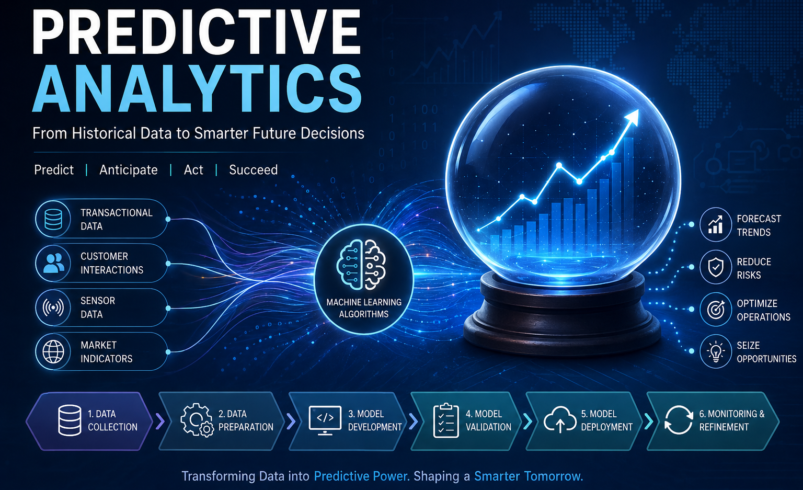

Predictive analytics stands as a cornerstone of modern data science, transforming how organizations anticipate future events and behaviors. By leveraging historical data, statistical algorithms, and machine learning techniques, it enables the forecasting of probabilities and trends, creating diverse predictive analytic worlds across virtually every sector. This capability moves beyond merely understanding what happened to predicting what will happen, offering a profound shift in strategic planning and operational efficiency. This article explores the fundamental concepts of predictive analytics, its operational mechanics, its widespread applications, and its evolving future, particularly with the integration of artificial intelligence.
Defining Predictive Analytics: What It Is and Why It Matters
At its core, what is predictive analytics? It is a branch of advanced analytics that uses new and historical data to make predictions about future events. It combines various techniques from data mining, statistics, modeling, machine learning, and artificial intelligence to analyze current and historical facts to make predictions about future or otherwise unknown events. The objective is not to tell you what will happen, but to assess the likelihood of a future outcome based on past patterns. This strategic importance lies in its ability to empower proactive decision-making, allowing businesses and institutions to optimize processes, mitigate risks, and seize opportunities before they fully materialize.
The Analytics Spectrum: How Predictive Analytics Fits Into Modern Data Strategy
To fully understand predictive analytic worlds, it helps to place predictive modeling within the broader four-stage data analytics maturity curve:
Descriptive Analytics:
What happened? (e.g., historical sales reporting, dashboard KPIs).
Diagnostic Analytics:
Why did it happen? (e.g., drill-down analysis, root cause discovery).
Predictive Analytics:
What is likely to happen? (e.g., churn probabilities, seasonal demand forecasting).
Prescriptive Analytics:
What should we do about it? (e.g., algorithmic decision automation, resource re-routing simulations).
While descriptive systems look through the rear-view mirror, predictive frameworks act as a radar system, providing the foundational foresight required before an enterprise can automate prescriptive business actions.
The Mechanics: How Predictive Analytics Works
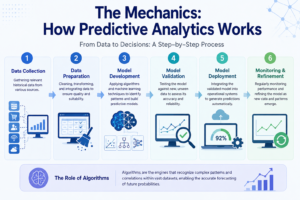
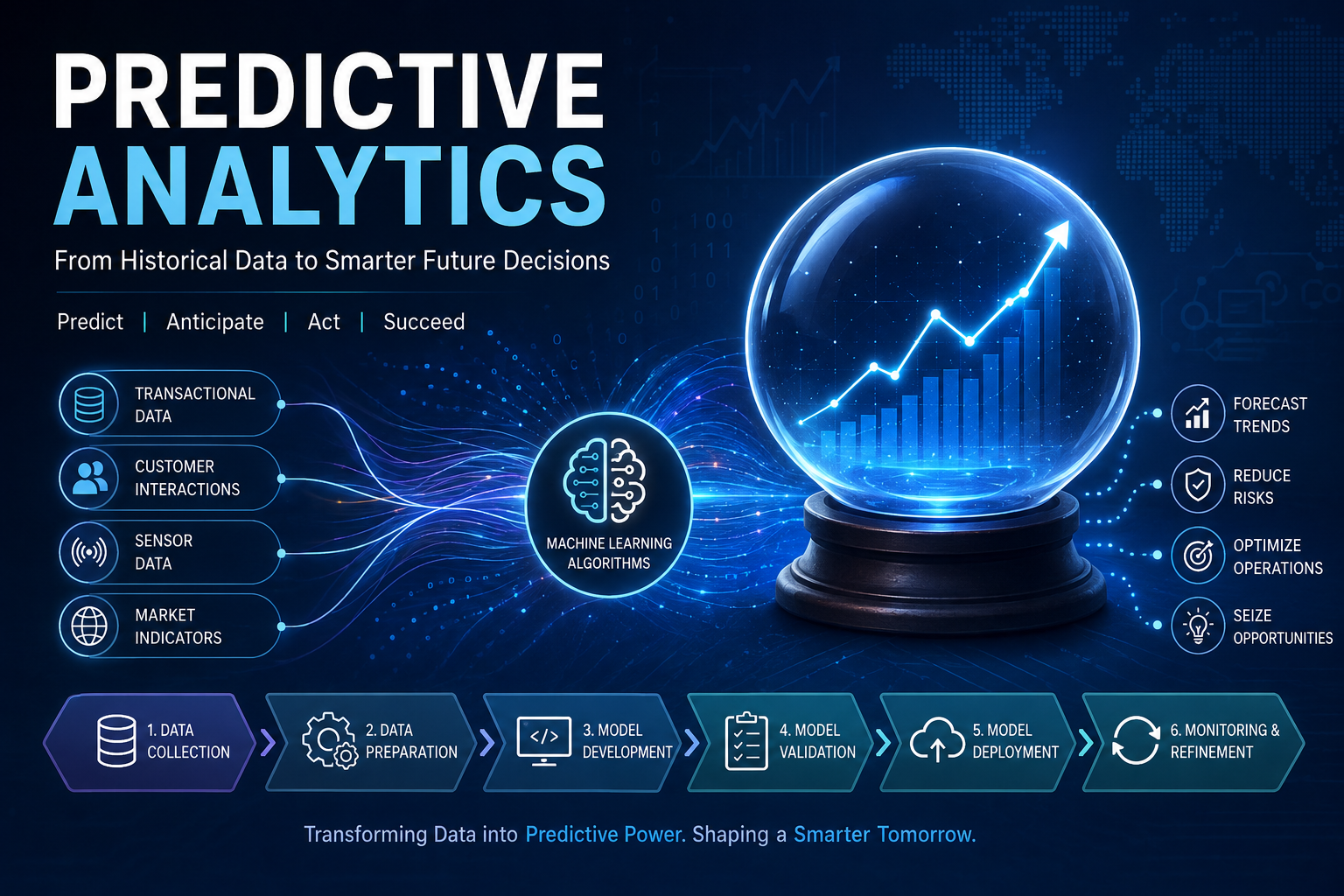
Understanding how predictive analytics works involves a systematic process that transforms raw data into actionable insights. This process typically includes several key stages:
- Data Collection: Gathering relevant historical data from various sources, such as transactional records, customer interactions, sensor data, and external market indicators.
- Data Preparation: Cleaning, transforming, and integrating the collected data to ensure its quality and suitability for analysis. This often involves handling missing values, outliers, and inconsistencies.
- Model Development: Applying statistical algorithms and machine learning techniques to the prepared data. Common methods include regression analysis, classification algorithms (e.g., decision trees, support vector machines), neural networks, and time series analysis. The goal is to identify patterns and relationships that can be used to build a predictive model.
- Model Validation: Testing the developed model against new, unseen data to assess its accuracy and reliability. This step ensures the model generalizes well beyond the training data.
- Model Deployment: Integrating the validated model into operational systems, allowing it to generate predictions automatically and continuously.
- Monitoring and Refinement: Regularly monitoring the model’s performance and recalibrating it as new data becomes available or underlying patterns shift. This ensures the model remains accurate and relevant over time.
The role of algorithms in this process is paramount, as they are the engines that recognize complex patterns and correlations within vast datasets, enabling the accurate forecasting of future probabilities.
Practitioner Insights: Navigating Real-World Modeling Trade-offs
In production environments, the lifecycle described above faces practical challenges that distinguish textbook theory from live engineering:
The 80/20 Rule of Data Engineering:
Seasoned data scientists routinely spend 70% to 80% of project time on feature engineering, pipeline sanitization, and addressing data leakage (where information from the target variable inadvertently leaks into the training features).
Managing Imbalanced Datasets:
In mission-critical applications like credit card fraud or rare disease detection, positive target instances often account for less than 0.1% of records. High overall accuracy is misleading in these scenarios; practitioners rely on precision, recall, F1-scores, and PR-AUC (Precision-Recall Area Under Curve) rather than simple accuracy metrics.
Combatting Drift in Live Systems:
Once deployed, predictive models inevitably degrade due to Concept Drift (shifts in statistical relationships between variables, such as spending changes after an economic shock) and Data Drift (changes in the distribution of input data). Robust production pipelines integrate continuous monitoring with automated retraining triggers using MLOps frameworks like MLflow, Kubeflow, or Apache Airflow.
Exploring Predictive Analytic Worlds: Real-World Applications
The broad applicability of predictive analytics has led to the emergence of distinct predictive analytic worlds across numerous sectors. These capabilities are reshaping industries by providing foresight into complex systems and individual behaviors.
Predictive Analytics in Business: Driving Strategic Decisions
Within the business landscape, predictive analytics in business offers a competitive edge through various applications. Here are some prominent predictive analytics examples:
- Customer Churn Prediction: Identifying customers likely to discontinue services, allowing businesses to intervene with retention strategies.
- Fraud Detection: Spotting unusual patterns in transactions or claims that indicate fraudulent activity, minimizing financial losses.
- Supply Chain Optimization: Forecasting demand fluctuations, optimizing inventory levels, and predicting potential disruptions to ensure efficient operations.
- Personalized Marketing: Predicting customer preferences and purchasing behavior to deliver targeted offers and content, enhancing engagement and sales.
- Demand Forecasting: Anticipating future product or service demand to optimize production, staffing, and resource allocation.
Beyond Commerce: Other Impactful Predictive Analytic Worlds
The influence of predictive analytics extends far beyond traditional commerce, creating new predictive analytic worlds in public services and scientific research. More predictive analytics examples include:
- Healthcare: Predicting disease outbreaks, identifying patients at high risk for certain conditions, and personalizing treatment plans based on individual patient data.
- Smart Cities: Optimizing traffic flow, predicting infrastructure maintenance needs, and managing energy consumption more efficiently.
- Environmental Science: Modeling climate change impacts, forecasting weather patterns, and predicting natural disasters.
- Finance: Assessing credit risk for loan applicants, predicting market trends, and detecting anomalies in financial transactions.
Cross-Industry Application Matrix
The following table summarizes common predictive modeling algorithms, their operational targets, and business benchmark metrics across major industries:
| Sector | Core Use Case | Preferred Algorithms & Models | Primary Success Metric |
| Retail & E-Commerce | Customer Lifetime Value (CLV) & Churn | Gradient Boosted Trees (XGBoost, LightGBM), Survival Analysis | Net Revenue Retention (NRR), Churn Reduction % |
| Financial Services | Transactional Fraud Detection | Isolation Forests, Graph Neural Networks (GNNs), Logistic Regression | Precision-Recall AUC, False Positive Rate (FPR) |
| Manufacturing | Predictive Equipment Maintenance (PdM) | Recurrent Neural Networks (LSTM), Random Forests on IoT Sensor Streams | Mean Time Between Failures (MTBF), Unplanned Downtime Reduction |
| Healthcare & Life Sciences | 30-Day Hospital Readmission Risk | Cox Proportional Hazards, Supervised Ensemble Classifiers | C-Statistic / ROC-AUC, Readmission Penalty Reductions |
| Logistics & Supply Chain | Dynamic Freight Pricing & Route Demand | Vector Autoregression (VAR), Prophet, Temporal Fusion Transformers | Mean Absolute Percentage Error (MAPE), SLA Compliance |
The Tangible Benefits of Predictive Analytics
Organizations that effectively implement predictive analytics realize significant advantages. The benefits of predictive analytics are multifaceted, leading to improved operational outcomes and strategic positioning:
- Improved Decision-Making: Providing data-driven insights that enable more informed and proactive strategic choices.
- Enhanced Efficiency: Optimizing processes, resource allocation, and operational workflows by anticipating future needs and challenges.
- Risk Mitigation: Identifying and quantifying potential risks, such as fraud, credit defaults, or equipment failures, allowing for timely preventative measures.
- Competitive Advantage: Gaining foresight into market trends and customer behavior, enabling businesses to innovate and respond faster than competitors.
- Optimized Resource Allocation: Ensuring that resources (staff, inventory, capital) are deployed where they will have the greatest impact, reducing waste and maximizing returns.
Enterprise Readiness: Key Implementation Hurdles & How to Solve Them
While the organizational upside is substantial, research from enterprise benchmarks indicates that a significant portion of predictive pilots struggle to reach scaled production. Addressing these core obstacles early determines project longevity:
- Fragmented Data Architecture: Siloed enterprise legacy databases prevent models from ingesting clean, cross-functional training features. Establishing centralized data lakehouses (e.g., Snowflake, Databricks, BigQuery) resolves feature isolation.
- The ‘Black Box’ Interpretability Problem: In highly regulated industries such as insurance and banking, models must satisfy strict compliance standards against biased or unexplainable outputs. Utilizing Explainable AI (XAI) frameworks—such as SHAP (SHapley Additive exPlanations) and LIME (Local Interpretable Model-agnostic Explanations)—allows data teams to expose feature attributions and audit model reasoning.
- Talent & Cultural Alignment: Predictive models do not produce value in a vacuum. Organizations need cross-functional translation between technical data teams and operational stakeholders to ensure business units trust and act on probabilistic model scores.
The Future of Predictive Analytic Worlds: AI’s Transformative Role
The evolution of predictive analytics is continuous, with models becoming increasingly sophisticated and integrated into daily operations. The future of predictive analytics is characterized by greater automation, real-time capabilities, and the expansion into even more complex domains. This ongoing advancement ensures the continuous growth and diversification of predictive analytic worlds.
AI in Predictive Analytics: Enhancing Accuracy and Automation
Artificial intelligence, particularly machine learning (ML) and deep learning (DL), is revolutionizing the field. AI in predictive analytics significantly enhances accuracy and automation by:
- Handling Vast Datasets: AI algorithms can process and derive insights from petabytes of structured and unstructured data, far beyond human capacity.
- Identifying Complex Patterns: ML and DL models excel at recognizing subtle, non-linear relationships and hidden patterns that traditional statistical methods might miss.
- Automating Model Creation and Refinement: AI can automate much of the model development lifecycle, from feature engineering to hyperparameter tuning, reducing manual effort and accelerating deployment.
- Enabling Real-time Predictions: With AI, predictive models can operate in real-time, providing immediate insights for dynamic decision-making, such as personalized recommendations or fraud alerts.
Emerging Trends: Foundation Models and Edge Predictive Systems
The intersection of generative AI and traditional predictive modeling is unlocking next-generation analytical capabilities:
- Predictive Fine-Tuning via LLMs & Multimodal Models: Rather than relying exclusively on numerical tabular data, modern predictive systems increasingly ingest unstructured contracts, video feeds, customer service call audio, and satellite imagery to forecast market trends and operational risks.
- Edge Analytics: Deploying compact, quantized predictive models directly on IoT sensors and edge computing hardware allows real-time inference without network latency, essential for autonomous vehicles, remote medical devices, and smart power grids.
- Synthetic Data for Model Robustness: To train predictive models without violating consumer data privacy laws (such as GDPR, CCPA, or HIPAA), organizations leverage generative models to create statistically faithful synthetic training datasets, accelerating model development while maintaining compliance.
Frequently Asked Questions (FAQ) About Predictive Analytics
Here are answers to common questions regarding predictive analytics:
Is predictive analytics the same as business intelligence?
Business intelligence (BI) focuses on analyzing past and present data to understand ‘what happened’ and ‘why’. Predictive analytics goes further to forecast ‘what will happen’.
What skills are needed for predictive analytics?
A strong foundation in statistics, mathematics, computer science, and domain knowledge is essential. Proficiency in programming languages like Python or R, and experience with machine learning frameworks, are also crucial.
Can predictive analytics predict with 100% certainty?
Predictive analytics deals with probabilities and likelihoods, not certainties. Its models provide the most probable outcomes based on available data, but external factors and inherent randomness mean no prediction is absolute.
What are the main challenges in implementing predictive analytics?
Challenges include data quality issues, the complexity of model development, the need for specialized talent, ethical considerations regarding data privacy and bias, and ensuring organizational adoption of data-driven insights.
What software and tools form the modern predictive analytics stack?
Industry-standard tech stacks include: Languages (Python with Pandas, NumPy, Scikit-learn; R with tidyverse, caret); Specialized ML Libraries (XGBoost, LightGBM, CatBoost, PyTorch, TensorFlow); Data & Feature Warehousing (Snowflake, BigQuery, Databricks, Feast); MLOps (MLflow, DVC, Kubeflow, Apache Airflow); Visualization (Tableau, Power BI, Streamlit).
How do organizations ensure algorithmic fairness and regulatory compliance?
Organizations implement algorithmic governance frameworks guided by standards like the NIST AI Risk Management Framework and the EU AI Act. Key practices include running regular disparate impact analyses, monitoring bias in training labels, utilizing model interpretability tools (like SHAP), and keeping human domain specialists in the loop for sensitive decision-making.
Conclusion: Shaping Tomorrow with Predictive Insights
Predictive analytics has moved from a niche analytical tool to an indispensable strategic asset, shaping countless aspects of business, science, and public life. The diverse predictive analytic worlds it creates offer unprecedented opportunities for foresight, optimization, and innovation. By understanding and leveraging these capabilities, organizations can navigate uncertainty with greater confidence, make more informed decisions, and proactively shape their future. As AI continues to advance, the power and pervasiveness of predictive analytics will only grow, making it an increasingly critical component for success and progress in an evolving world.