


Achieving organic visibility for any website relies on a deep understanding and consistent application of fundamental guidelines. These guidelines, collectively known as SEO principles, dictate how search engines discover, evaluate, and rank web content. Understanding what are SEO principles is the first step toward connecting users with relevant information and services, ensuring your digital presence is not just online, but discoverable and impactful.
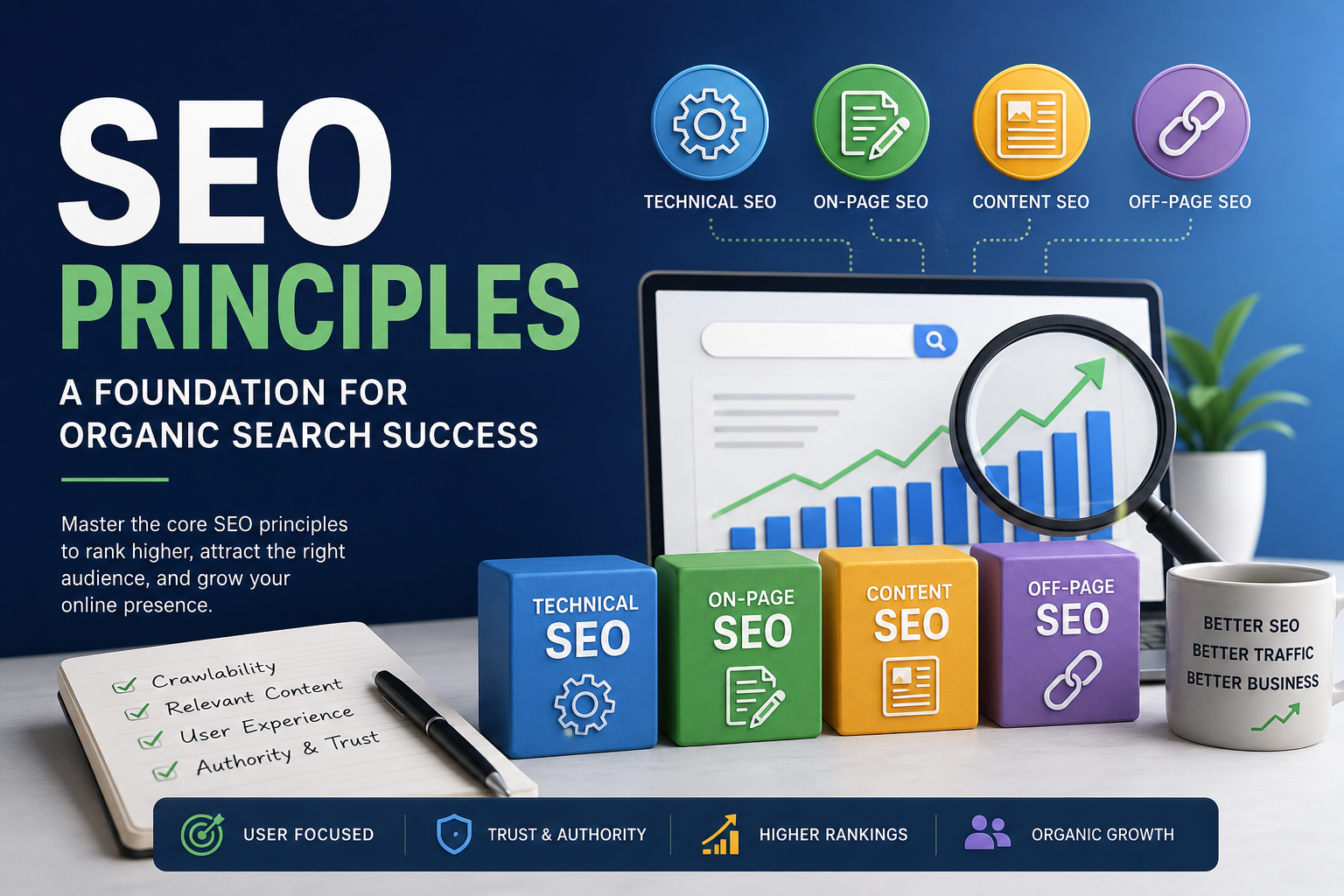
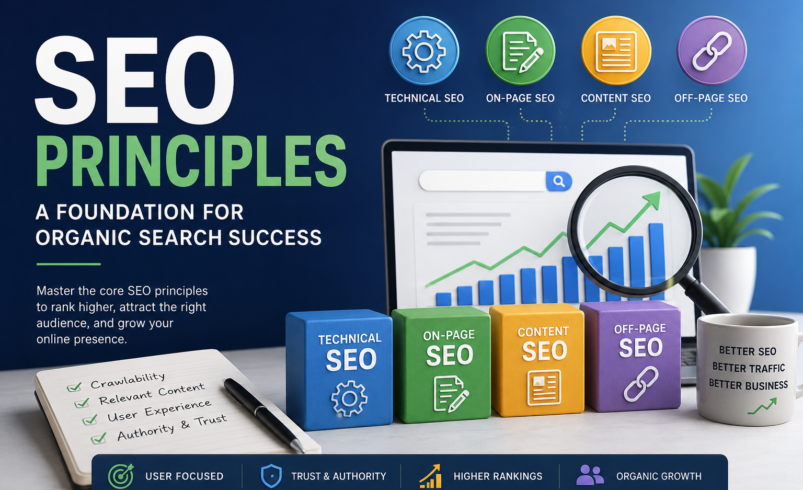
The 4 Pillars of Search Engine Optimization: Quick Summary
| SEO Pillar | Primary Focus Area | Key Impact on Visibility | Primary Diagnostic Tools |
| Technical SEO | Crawlability, indexability, site speed, and site architecture | Ensures search bots can parse and render your pages without barriers | Google Search Console, Screaming Frog, PageSpeed Insights |
| On-Page SEO | Content structure, keyword placement, meta tags, and internal links | Helps algorithms interpret page relevance and semantic topical context | Google Search Console, Yoast/RankMath, Surfer SEO |
| Content SEO | Meeting user search intent, depth, information gain, and E-E-A-T | Drives user engagement, organic rankings, dwell time, and conversions | Google Trends, AnswerThePublic, Search Console (Queries) |
| Off-Page SEO | High-authority backlinks, unlinked brand mentions, and digital PR | Builds domain authority, external trust, and industry prominence | Ahrefs, Semrush, Moz Link Explorer |
The Core SEO Principles: A Holistic Approach
Effective search engine optimization is never a singular effort; it demands attention across multiple interconnected domains. The core SEO principles encompass a holistic strategy that integrates on-page, off-page, technical, and content-specific elements. Neglecting any one area can undermine efforts in others, highlighting the necessity of a comprehensive approach to achieve and maintain high search rankings.
On-Page SEO Principles: Optimizing Your Content and Structure
On-page SEO principles refer to all optimizations applied directly to your website’s pages. These elements are within your direct control and are crucial for helping search engines understand your content’s relevance and value to users.
Keyword Research and Strategic Placement seo principles
Identifying the terms and phrases your target audience uses to find information is foundational. Thorough keyword research informs content creation, ensuring your pages address actual user queries. Strategic, natural placement of these keywords within headings, body text, and meta descriptions signals relevance to search engines without resorting to keyword stuffing.
Strategic Keyword Placement Checklist:
- Page Title (H1): Place your target keyword as close to the front as naturally possible.
- First 100 Words: Introduce the main search topic early to immediately confirm relevance for both human readers and search engines.
- Subheadings (H2, H3): Seamlessly incorporate secondary, long-tail, and semantic variations without disrupting readability.
- Image Alt Text: Clearly describe visual media using descriptive phrasing that naturally includes relevant search terms.
- Anchor Text: Use descriptive, relevant keyword variations in contextual internal links rather than generic phrases like “click here.”
High-Quality, User-Centric Content
Content that is valuable, informative, and engaging is paramount. It must directly address user intent, provide comprehensive answers, and offer solutions to their problems. Search engines prioritize content that demonstrates expertise, authoritativeness, and trustworthiness (E-A-T), ultimately serving the user’s best interest.
Demonstrating Google’s E-E-A-T (Experience, Expertise, Authoritativeness, and Trustworthiness)
Google has expanded its evaluation framework to emphasize first-hand Experience (E-E-A-T). To ensure your content fulfills these expectations:
- Display Hands-on Experience: Incorporate unique operational steps, personal testing observations, real-world case studies, screenshots, and original images rather than generic stock graphics.
- Showcase Verified Expertise: Highlight transparent author bios detailing relevant industry credentials, professional history, and accredited subject-matter achievements.
- Build Site Authoritativeness: Establish depth through comprehensive topical clusters, publish original research or survey data, and build an identifiable industry footprint that other authoritative platforms reference.
- Establish Transparent Trust: Provide clear contact details, direct editorial policies, explicit corrections logs, accessible privacy terms, and fact-checked citations to trusted primary sources.
Optimized Meta Tags and Descriptions
Title tags and meta descriptions are your website’s storefront in search results. A compelling title tag, incorporating relevant keywords, and an enticing meta description encourage clicks. These elements don’t directly influence ranking as much as they influence click-through rates, which is an indirect ranking signal.
Logical URL Structure and Internal Linking of seo principles
Clear, descriptive URLs that reflect page content improve user experience and provide search engines with additional context. A robust internal linking strategy connects related content, improves site navigation, and distributes link equity across your website, reinforcing the hierarchy and importance of various pages.
Topic Clusters and Hub-and-Spoke Architecture
A powerful internal linking method involves establishing a hub-and-spoke (topic cluster) model. In this setup, a top-level pillar page provides an exhaustive overview of a core subject (the “hub”), while dedicated supplementary articles cover granular, long-tail subtopics (the “spokes”). Every spoke page includes a contextual internal link pointing back to the pillar page, and the pillar links out to each cluster piece. This internal link equity loop signals comprehensive topical authority to search engines while allowing crawl bots to index related URLs efficiently.
Off-Page SEO Principles: Building Authority and Trust
Off-page SEO principles involve actions taken outside of your website to influence its ranking. These signals demonstrate your site’s authority, trustworthiness, and popularity to search engines.
Strategic Backlink Acquisition
Backlinks from reputable, relevant websites act as votes of confidence. Earning high-quality backlinks through valuable content, outreach, and genuine relationships is a cornerstone of off-page SEO. The focus should always be on natural link building rather than manipulative tactics, which can incur penalties.
Proven White-Hat Backlink Acquisition Tactics:
- Original Data and Industry Benchmarks: Publish original surveys, proprietary platform data, or analytical industry reports that journalists, trade bloggers, and researchers naturally cite as reference sources.
- Digital PR and Expert Commentary: Pitch your verified insights and commentary on trending developments through digital PR platforms, media roundups, podcasts, and reputable trade publications.
- Resource and Asset Creation: Develop free tools, calculative templates, downloadable guides, or interactive visual assets that naturally attract editorially placed inbound links.
- Unlinked Brand Mention Outreach: Track online publications mentioning your brand or research assets without an outbound link, and send a polite note requesting attribution.
Brand Mentions and Online Reputation
Mentions of your brand, even without direct links, contribute to your online authority. Search engines recognize these mentions as indicators of brand prominence and relevance. Managing your online reputation, engaging in social media, and fostering positive brand sentiment indirectly support your off-page SEO efforts.
Local SEO Principles: Expanding Regional Visibility
For businesses that serve physical geographic areas or specific communities, local search engine optimization is a crucial off-page and on-page discipline:
- Google Business Profile (GBP) Optimization: Maintain a complete, verified Google Business Profile featuring precise categories, updated hours of operation, photos, services, and product catalogs.
- NAP Consistency: Ensure your company’s Name, Address, and Phone number (NAP) are uniformly formatted across your website, social channels, maps, and trusted regional directories.
- Customer Reviews and Local Feedback: Cultivate authentic customer reviews across your Google Business Profile and industry-specific directories, actively answering both positive and negative comments to demonstrate accountability and responsiveness.
- Localized On-Page Signals: Build localized landing pages containing schema markup (LocalBusiness), embedded directions, geographic identifiers, and community-oriented content.
Technical SEO Principles: Ensuring Site Health and Accessibility
Technical SEO principles focus on the infrastructure of your website, ensuring search engines can efficiently crawl, index, and understand your content. A technically sound website is the bedrock for all other SEO efforts.
Site Speed and Core Web Vitals
Fast loading times are critical for user experience and are a direct ranking factor. Google’s Core Web Vitals (Largest Contently Paint, First Input Delay, Cumulative Layout Shift) measure real-world user experience and significantly impact search rankings. Optimizing images, leveraging browser caching, and using efficient hosting are key.
Note on Core Web Vitals Updates:
Google continuously refines real-world performance benchmarks. Significantly, Interaction to Next Paint (INP) has replaced First Input Delay (FID) as the primary official metric measuring page responsiveness, assessing the overall latency of all user clicks, taps, and keyboard interactions across the entire lifecycle of a page visit. Maintaining smooth JavaScript execution and minimizing main-thread blocking are vital for meeting target INP thresholds (< 200 milliseconds).
Mobile-Friendliness and Responsive Design
With mobile-first indexing, a mobile-responsive website is no longer optional. Your site must provide an optimal viewing and interaction experience across all devices. This ensures accessibility for the majority of users and favorable treatment by search engines.
Crawlability, Indexability, and Structured Data
Search engines need to access and understand your content. XML sitemaps guide crawlers, while a properly configured robots.txt file prevents indexing of irrelevant pages. Implementing structured data (schema markup) helps search engines interpret the context of your content, leading to richer search results (rich snippets).
Common Schema Types to Implement:
- Article / NewsArticle / BlogPosting: Establishes your headline, author credentials, publisher identity, and publication dates.
- Organization / LocalBusiness: Defines core business attributes, headquarters locations, official logos, and operational contact points.
- FAQPage: Clarifies questions and answers, increasing the likelihood of rich search snippet eligibility on SERPs.
- Product and Review: Communicates pricing, in-stock availability, and aggregate star ratings directly on search engine listing panels.
- BreadcrumbList: Clarifies site hierarchy and visual navigation pathways for both search engines and desktop/mobile users.
Website Security (HTTPS)
An SSL certificate, indicated by HTTPS in your URL, encrypts data between the user and your website. This is a minor ranking signal but a significant trust factor for users. Secure websites are preferred by search engines and users alike.
Content SEO Principles: Crafting for Engagement and Authority
Beyond keywords and technical aspects, the quality and relevance of your content are paramount. Content SEO principles guide the creation of material that not only ranks but also resonates with your audience.
Aligning with User Intent
Every piece of content should serve a specific user intent—informational, navigational, transactional, or commercial investigation. Content that precisely answers the user’s question or fulfills their need is more likely to rank well and retain visitors.
Information Gain: Adding Value Beyond Existing Search Results
Search engine algorithms reward content that provides measurable “information gain”—meaning it delivers net-new insights, novel datasets, expert viewpoints, or unique perspectives that do not merely rewrite the top 10 search results. To maximize information gain:
- Conduct original experiments or test industry assertions directly to present fresh, uncopied conclusions.
- Add downloadable templates, step-by-step custom workflows, or interactive calculation tools.
- Source original quotes and expert commentary from acknowledged authorities and industry specialists.
- Offer counter-intuitive arguments or nuanced industry trade-offs rather than generic high-level summaries.
Readability and Content Structure
Well-structured content with clear headings, short paragraphs, bullet points, and appropriate visuals enhances readability. This improves user engagement and helps search engines parse and understand the content’s main points. Clear, concise writing is always preferred.
Semantic SEO, Entities, and Natural Language Processing
Modern search engines utilize advanced Natural Language Processing (NLP) models and knowledge graphs to understand concepts, objects, and relationships rather than matching isolated keywords. To capitalize on semantic search principles:
- Focus on Entity Associations: Write about your topic with its related concepts, industry terminology, authoritative figures, and connected subtopics.
- Answer Conversational Inquiries: Optimize for voice search and conversational language interfaces by writing clear, succinct direct answers to common customer questions.
- Structure Semantic Content: Use contextual subheadings, unordered lists, definitions, and distinct data tables that algorithms can easily extract for featured snippets and dynamic search summaries.
How SEO Principles Work Together for Ranking Success
The various facets of SEO are not isolated; they are deeply interconnected. How SEO principles work is through a synergistic relationship where improvements in one area amplify the effects in others. For instance, excellent on-page content becomes more discoverable with strong technical SEO, and its authority is boosted by robust off-page signals. A fast, mobile-friendly site (technical SEO) encourages users to stay longer and engage with high-quality content (on-page and content SEO), which in turn can attract more backlinks (off-page SEO). This integrated approach is what drives sustainable ranking success.
Implementing SEO Best Practices and Google’s Guidelines
Applying these principles effectively requires a strategic mindset focused on continuous improvement. Adhering to SEO best practices and aligning with Google SEO principles is crucial for long-term organic growth.
Regular Audits and Performance Monitoring
Consistently auditing your website for technical issues, content gaps, and backlink opportunities is essential. Monitoring key performance indicators (KPIs) such as organic traffic, keyword rankings, and conversion rates helps identify areas for improvement and validate strategy adjustments.
The Comprehensive SEO Audit Checklist
| Audit Category | Verification Item | Remediation Action |
| Technical Health | Check for crawl errors, redirect loops, and 404 responses | Inspect Google Search Console Page Indexing reports; set clean 301 redirects for broken paths |
| Index Control | Review robots.txt disallow rules and XML sitemaps | Confirm important content pages are not blocked and only canonical URLs are listed |
| On-Page Optimization | Scan for duplicate or missing title tags and H1 elements | Ensure each indexable page features an informative, unique title tag and single descriptive H1 |
| Content Performance | Identify decaying pages and pages with declining organic clicks | Consolidate cannibalizing posts, refresh outdated references, or prune zero-value URLs |
| Link Integrity | Audit internal links and external backlink profiles | Eliminate internal broken links, replace redirected internal paths, and evaluate toxic anchor text |
Staying Updated with Algorithm Changes
Search engine algorithms evolve. Staying informed about major updates and understanding their implications allows you to adapt your strategy proactively. This continuous learning ensures your SEO efforts remain effective and compliant with the latest guidelines.
Common SEO Mistakes and Myths to Avoid
- The Keyword Density Fallacy: Striving for an arbitrary percentage target for keywords leads to unnatural prose and can trigger spam filters. Focus instead on natural language and comprehensive topic coverage.
- Ignoring Search Intent Mismatch: Producing long informational guides for keywords dominated by transactional landing pages wastes resources; always match your page format to the primary intent displayed in the SERP.
- Treating Technical SEO as a One-Time Task: Technical site performance degrades over time with software updates, theme alterations, and broken redirects; it demands ongoing monitoring and continuous maintenance.
- Prioritizing Backlink Volume Over Relevance: Accumulating low-grade links from link farms or unrelated websites risks algorithmic filtering or manual search penalties. Emphasize authoritative, contextually aligned links.
- Overlooking Internal Links: Relying solely on external link generation while leaving deep, informational articles orphaned within your site structure harms both crawlability and topical authority.
Frequently Asked Questions About SEO Principles
What are the most critical SEO principles for a new website?
For a new website, focus on foundational elements: creating high-quality, user-centric content that addresses specific user intent, ensuring technical crawlability and indexability, and securing your site with HTTPS. These initial what are SEO principles lay the groundwork for future growth.
How often should I review my SEO principles strategy?
Your SEO principles strategy should be reviewed and adapted regularly, ideally quarterly for major strategic adjustments and monthly for performance monitoring and tactical tweaks. Algorithm updates and competitive landscape changes necessitate ongoing attention.
Can I achieve good rankings by focusing on only one type of SEO principle?
While focusing on one area might yield some short-term gains, sustainable good rankings require a comprehensive approach. Neglecting any of the core SEO principles—on-page, off-page, technical, or content—will limit your potential and leave your site vulnerable to competitors who adopt a holistic strategy.
How long does it typically take to see results from applying SEO principles?
Organic search engine optimization is an ongoing, compounding investment. For a newly launched website or an unranked domain, seeing consistent rank improvements and traffic traction generally takes 3 to 6 months. Established sites optimizing existing pages or improving technical crawlability can often observe positive ranking adjustments within several days to a few weeks, depending on crawl frequency and industry competitiveness.
What is the difference between white-hat and black-hat SEO principles?
White-hat SEO principles adhere strictly to search engine webmaster guidelines, focusing on user-first experiences, organic backlink acquisition, and accurate metadata. Black-hat tactics attempt to manipulate search engine algorithms through deceptive techniques such as hidden text, keyword stuffing, automated content generation with no value-add, or purchasing private blog network (PBN) backlinks. Black-hat practices risk manual actions and algorithmic search penalties.
How are generative search engines and AI Overviews impacting core SEO principles?
AI-powered search features summarize answers directly in results pages, placing higher priority on concise, easily extractable factual data, structured schema, and verifiable E-E-A-T. While baseline technical crawlability and user-intent alignment remain foundational, webmasters must emphasize high “information gain,” unique primary data, and brand authority to be selected as cited sources in AI summaries.
Conclusion:
The Enduring Value of Sound SEO Principles
The consistent application of sound SEO principles is not merely a tactic; it is a fundamental investment in your website’s long-term organic visibility and success. By prioritizing user experience, technical integrity, authoritative content, and external credibility, businesses can build a robust online presence that attracts and retains their target audience. These principles form the bedrock of any successful digital strategy, ensuring your content reaches those who need it most.