




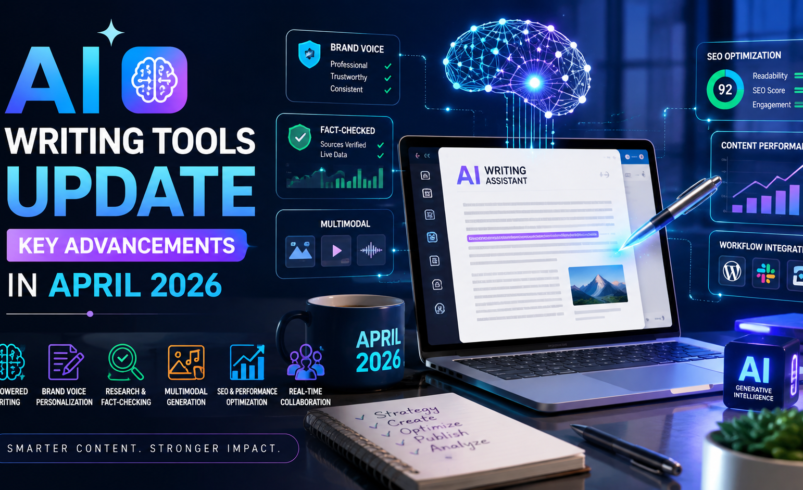

Major AI Writing tools update Software Trends Shaping 2026
The first quarter of 2026 has solidified several overarching AI writing software trends 2026 that are driving the industry forward. We are observing a move towards more autonomous, context-aware, and integrated systems. These advancements are pushing the boundaries of what AI can achieve in text generation, moving beyond simple content creation to strategic content orchestration. Significant AI text generation advancements are evident across the board, from foundational models to specialized applications.
Comparative Overview: 2024 vs. 2026 AI Writing Architecture
Capability Dimension Legacy AI Writers (2024 Baseline)Current Generation (April 2026 Update)Context Window & Ingestion8k–32k tokens; frequent context drift on long assets1M–2M+ tokens; native whole-corpus multi-document grounding Brand Voice Alignment Static adjective prompts (“Write in a professional tone”)Vector RAG style-guide mapping and dynamic few-shot prompt injection Multimodal Generation Text-only drafts requiring manual design asset creation Inline synchronized visual, audio summary, and structured metadata generation Fact Verification High hallucination risk; post-generation manual search Live Web/API grounding with inline token citation attribution
Enhanced Personalization and Brand Voice Consistency
Among the most impactful new AI writing features 2026 is the dramatic improvement in personalization and brand voice consistency. AI tools are now capable of ingesting vast amounts of brand guidelines, style guides, and existing content to learn and replicate a specific brand’s unique tone, vocabulary, and messaging nuances with remarkable accuracy. This means content generated by AI can seamlessly integrate into a brand’s established communication strategy, reducing the need for extensive human editing to align with brand identity. Tools can now adapt content for different audience segments while maintaining the core brand voice, ensuring a cohesive experience across all touchpoints.
Technical Deep Dive: How RAG Pipelines Power Voice Consistency
Modern platforms maintain brand voice through Retrieval-Augmented Generation (RAG) vector embeddings rather than generic system prompts. Instead of relying on vague descriptors like “conversational yet authoritative,” modern tools convert a brand’s published repository (blog archives, whitepapers, PR guidelines) into vector databases. When generating a new draft, semantic similarity matching retrieves actual sentence structures, vocabulary constraints, and banned phrases directly from the company’s verified corpus, achieving precise stylistic mimicry.
Multimodal Generative AI for Content Creation Updates
The concept of content creation has expanded significantly with the latest generative AI for content creation updates. AI is no longer confined to text alone. We are seeing robust integrations that allow AI writing tools to generate accompanying images, short video clips, and even audio narration based on a textual prompt or generated article. This multimodal capability streamlines the content production pipeline, enabling creators to produce rich, engaging content packages from a single input. For instance, an AI can draft a blog post and simultaneously suggest or create relevant visuals and audio snippets, significantly accelerating the creation of comprehensive digital assets.
Real-time Collaboration and Workflow Integration
The utility of AI assistant tools for writers 2026 has been greatly enhanced through real-time collaboration features and deeper workflow integrations. Modern AI writing platforms now offer shared workspaces where multiple team members can collaborate on AI-generated drafts, provide feedback, and make edits simultaneously. Furthermore, these ai writing tools updates are integrating more seamlessly with popular content management systems (CMS), project management software, and digital asset management (DAM) platforms. This integration minimizes friction in the content lifecycle, allowing AI-generated content to flow directly into publishing queues or review processes, thereby improving overall team efficiency and reducing manual data transfer.
Enterprise Implementation: Human-in-the-Loop (HITL) Workflow Checklist
Step 1 (Strategy & Ingestion): Feed campaign briefs and brand negative-keyword lists directly via CMS plugin or API webhooks.
Step 2 (Autonomous First Draft): Run multimodal generation for text, structured tables, visual prompts, and social media derivative copy.
Step 3 (Subject Matter Expert Review): Verify original data points, interview quotes, and proprietary insights to fulfill Google’s Experience criteria.
Step 4 (Automated Grounding Check): Run built-in semantic citation audits to confirm that stats point to live, verifiable URLs.
Step 5 (Direct Staging Sync): Push reviewed copy directly to WordPress, Webflow, or headless CMS staging environments with structured Schema markup attached.
Key Updates from Leading AI Content Generators in April 2026
The first quarter of 2026 has brought a wave of improvements across various platforms, reflecting the broader AI copywriting tools latest news. While specific product names are not the focus here, the categories of advancements highlight a collective push towards more intelligent, reliable, and user-friendly systems. These updates are making the best AI content generators April 2026 more indispensable for marketers and content teams.
Advanced Research and Fact-Checking Capabilities
A critical area of AI text generation advancements involves enhanced research and fact-checking. AI writing tools updates are now equipped with more sophisticated mechanisms to access and synthesize information from a wider array of reputable sources, including academic databases, verified news outlets, and industry reports. This leads to content that is not only well-written but also factually accurate and supported by current data. Some systems now incorporate real-time verification against established knowledge bases, flagging potential inaccuracies or outdated information during the generation process, thereby significantly improving content reliability.
Addressing the Attribution Bottleneck: Source Grounding Standards
While early generative tools relied solely on parametric memory (often hallucinating facts or non-existent URLs), April 2026 advancements implement strict search grounding protocols. Models now generate text with bidirectional pointer references that link factual assertions directly to indexed, real-time web sources. Content teams should verify that their AI workflows surface dynamic confidence scores, warning editors whenever an external claim lacks a corroborating primary source.
Improved SEO and Performance Optimization Features
The ai writing tools update april 2026 includes substantial improvements in SEO and performance optimization. AI content generators are now offering more granular control over keyword integration, semantic SEO analysis, and content structure optimization. They can analyze search intent with greater precision, suggest optimal content length and readability scores, and even predict content performance based on current search trends and competitor analysis. This allows creators to produce content that is not only engaging but also highly optimized for search engine visibility and audience engagement from the outset.
Navigating Information Gain & Google Search Guidance
Search engines increasingly penalize derivative, regurgitated AI summaries that offer no unique value. To maintain high organic visibility, modern SEO integration in AI writing tools update prioritizes Information Gain Scores—identifying content angles, original data representations, and actionable frameworks that competing top-ranking pages fail to cover. SEO optimization in 2026 focuses less on static keyword density and more on entity-relationship mapping, search intent coverage, and structured data schemas (such as Article, FAQ Page, and How To JSON-LD).
The Future of AI Writing Technology: What’s Next?
Looking ahead, the future of AI writing tools update technology promises even more transformative capabilities. We anticipate further integration of emotional intelligence, allowing AI to craft content that resonates more deeply with human readers on a psychological level. Ethical considerations around AI-generated content, including transparency and bias detection, will likely become standard features. The development of truly autonomous content strategies, where AI can identify content gaps, generate ideas, create content, and even distribute it across channels, is on the horizon. This will empower content teams to focus on higher-level strategy and creative oversight, while AI handles much of the execution.
AI Governance, Copyright, and Content Authenticity Frameworks
As generative text expands into enterprise publishing, governance frameworks are becoming mandatory. Emerging legal standards worldwide require businesses to disclose whether content is entirely synthesized or co-authored with AI. Furthermore, the adoption of C2PA metadata standards (content credentials embedded directly in file metadata) and cryptographic watermarking is enabling publishers to establish clear provenance, mitigating copyright liability and maintaining consumer trust.
Frequently Asked Questions About AI Writing Tools in 2026
Here are some common questions regarding the ai writing tools update april 2026 and their implications:
Are AI-generated articles truly original? Yes, modern AI models are designed to generate unique content that passes plagiarism checks. They synthesize information rather than copying it directly.
Will AI writing tools replace human writers? AI tools are evolving as powerful assistants, not replacements. They automate repetitive tasks and generate drafts, allowing human writers to focus on strategy, creativity, and nuanced editing.
How do these updates address ethical concerns like bias? Developers are increasingly implementing bias detection and mitigation techniques. Users also have more control over parameters to guide content generation responsibly.
What skills are essential for writers working with AI tools? Critical thinking, prompt engineering, editing, fact-checking, and understanding audience psychology remain crucial. The ability to effectively guide and refine AI output is paramount.
Are these advanced tools accessible to small businesses? Many platforms offer tiered pricing, making advanced features available to businesses of all sizes. The trend is towards greater accessibility and user-friendliness.
How does Google evaluate AI-assisted content under E-E-A-T guidelines? Google evaluates content based on quality, value, and information gain rather than how it was produced. However, purely automated content lacking first-hand experience, transparent sourcing, or expert human review frequently struggles to rank. High-ranking content requires human subject-matter expertise, verified data citations, and clear editorial oversight.
What is the difference between custom RAG systems and simple system prompts for brand voice? Simple system prompts offer basic instructions (e.g., “be professional”), which can easily break during complex conversations. Custom RAG (Retrieval-Augmented Generation) connects the AI writer directly to an active database of your company’s actual approved documents, retrieving exact vocabulary, tone examples, and facts in real time to prevent brand drift.
Conclusion: Adapting to the Latest AI Writing Advancements
The ai writing tools update april 2026 underscores a period of significant innovation and maturation in artificial intelligence for content creation. From enhanced personalization and multimodal capabilities to advanced research and SEO optimization, these tools are becoming increasingly sophisticated and integral to modern content strategies. For writers, marketers, and businesses, staying informed about these advancements and actively integrating them into workflows is essential. Embracing these technologies allows for greater efficiency, consistency, and the production of higher-quality, more impactful content.
Major AI Writing tools update Software Trends Shaping 2026
The first quarter of 2026 has solidified several overarching AI writing software trends 2026 that are driving the industry forward. We are observing a move towards more autonomous, context-aware, and integrated systems. These advancements are pushing the boundaries of what AI can achieve in text generation, moving beyond simple content creation to strategic content orchestration. Significant AI text generation advancements are evident across the board, from foundational models to specialized applications.
Comparative Overview: 2024 vs. 2026 AI Writing Architecture
Capability Dimension Legacy AI Writers (2024 Baseline)Current Generation (April 2026 Update)Context Window & Ingestion8k–32k tokens; frequent context drift on long assets1M–2M+ tokens; native whole-corpus multi-document grounding Brand Voice Alignment Static adjective prompts (“Write in a professional tone”)Vector RAG style-guide mapping and dynamic few-shot prompt injection Multimodal Generation Text-only drafts requiring manual design asset creation Inline synchronized visual, audio summary, and structured metadata generation Fact Verification High hallucination risk; post-generation manual search Live Web/API grounding with inline token citation attribution
Enhanced Personalization and Brand Voice Consistency
Among the most impactful new AI writing features 2026 is the dramatic improvement in personalization and brand voice consistency. AI tools are now capable of ingesting vast amounts of brand guidelines, style guides, and existing content to learn and replicate a specific brand’s unique tone, vocabulary, and messaging nuances with remarkable accuracy. This means content generated by AI can seamlessly integrate into a brand’s established communication strategy, reducing the need for extensive human editing to align with brand identity. Tools can now adapt content for different audience segments while maintaining the core brand voice, ensuring a cohesive experience across all touchpoints.
Technical Deep Dive: How RAG Pipelines Power Voice Consistency
Modern platforms maintain brand voice through Retrieval-Augmented Generation (RAG) vector embeddings rather than generic system prompts. Instead of relying on vague descriptors like “conversational yet authoritative,” modern tools convert a brand’s published repository (blog archives, whitepapers, PR guidelines) into vector databases. When generating a new draft, semantic similarity matching retrieves actual sentence structures, vocabulary constraints, and banned phrases directly from the company’s verified corpus, achieving precise stylistic mimicry.
Multimodal Generative AI for Content Creation Updates
The concept of content creation has expanded significantly with the latest generative AI writing tools for content creation updates. AI is no longer confined to text alone. We are seeing robust integrations that allow AI writing tools to generate accompanying images, short video clips, and even audio narration based on a textual prompt or generated article. This multimodal capability streamlines the content production pipeline, enabling creators to produce rich, engaging content packages from a single input. For instance, an AI can draft a blog post and simultaneously suggest or create relevant visuals and audio snippets, significantly accelerating the creation of comprehensive digital assets.
Real-time Collaboration and Workflow Integration
The utility of AI assistant tools for writers 2026 has been greatly enhanced through real-time collaboration features and deeper workflow integrations. Modern AI writing platforms now offer shared workspaces where multiple team members can collaborate on AI-generated drafts, provide feedback, and make edits simultaneously. Furthermore, these ai writing tools updates are integrating more seamlessly with popular content management systems (CMS), project management software, and digital asset management (DAM) platforms. This integration minimizes friction in the content lifecycle, allowing AI-generated content to flow directly into publishing queues or review processes, thereby improving overall team efficiency and reducing manual data transfer.
Enterprise Implementation: Human-in-the-Loop (HITL) Workflow Checklist
Step 1 (Strategy & Ingestion): Feed campaign briefs and brand negative-keyword lists directly via CMS plugin or API webhooks.
Step 2 (Autonomous First Draft): Run multimodal generation for text, structured tables, visual prompts, and social media derivative copy.
Step 3 (Subject Matter Expert Review): Verify original data points, interview quotes, and proprietary insights to fulfill Google’s Experience criteria.
Step 4 (Automated Grounding Check): Run built-in semantic citation audits to confirm that stats point to live, verifiable URLs.
Step 5 (Direct Staging Sync): Push reviewed copy directly to WordPress, Webflow, or headless CMS staging environments with structured Schema markup attached.
Key Updates from Leading AI Content Generators in April 2026
The first quarter of 2026 has brought a wave of improvements across various platforms, reflecting the broader AI copywriting tools latest news. While specific product names are not the focus here, the categories of advancements highlight a collective push towards more intelligent, reliable, and user-friendly systems. These updates are making the best AI content generators April 2026 more indispensable for marketers and content teams.
Advanced Research and Fact-Checking Capabilities
A critical area of AI text generation advancements involves enhanced research and fact-checking. AI writing tools updates are now equipped with more sophisticated mechanisms to access and synthesize information from a wider array of reputable sources, including academic databases, verified news outlets, and industry reports. This leads to content that is not only well-written but also factually accurate and supported by current data. Some systems now incorporate real-time verification against established knowledge bases, flagging potential inaccuracies or outdated information during the generation process, thereby significantly improving content reliability.
Addressing the Attribution Bottleneck: Source Grounding Standards
While early generative tools relied solely on parametric memory (often hallucinating facts or non-existent URLs), April 2026 advancements implement strict search grounding protocols. Models now generate text with bidirectional pointer references that link factual assertions directly to indexed, real-time web sources. Content teams should verify that their AI workflows surface dynamic confidence scores, warning editors whenever an external claim lacks a corroborating primary source.
Improved SEO and Performance Optimization Features
The ai writing tools update april 2026 includes substantial improvements in SEO and performance optimization. AI content generators are now offering more granular control over keyword integration, semantic SEO analysis, and content structure optimization. They can analyze search intent with greater precision, suggest optimal content length and readability scores, and even predict content performance based on current search trends and competitor analysis. This allows creators to produce content that is not only engaging but also highly optimized for search engine visibility and audience engagement from the outset.
Navigating Information Gain & Google Search Guidance
Search engines increasingly penalize derivative, regurgitated AI summaries that offer no unique value. To maintain high organic visibility, modern SEO integration in AI writing tools update prioritizes Information Gain Scores—identifying content angles, original data representations, and actionable frameworks that competing top-ranking pages fail to cover. SEO optimization in 2026 focuses less on static keyword density and more on entity-relationship mapping, search intent coverage, and structured data schemas (such as Article, FAQPage, and HowTo JSON-LD).
The Future of AI Writing Technology: What’s Next?
Looking ahead, the future of AI writing tools update technology promises even more transformative capabilities. We anticipate further integration of emotional intelligence, allowing AI to craft content that resonates more deeply with human readers on a psychological level. Ethical considerations around AI-generated content, including transparency and bias detection, will likely become standard features. The development of truly autonomous content strategies, where AI can identify content gaps, generate ideas, create content, and even distribute it across channels, is on the horizon. This will empower content teams to focus on higher-level strategy and creative oversight, while AI handles much of the execution.
AI Governance, Copyright, and Content Authenticity Frameworks
As generative text expands into enterprise publishing, governance frameworks are becoming mandatory. Emerging legal standards worldwide require businesses to disclose whether content is entirely synthesized or co-authored with AI. Furthermore, the adoption of C2PA metadata standards (content credentials embedded directly in file metadata) and cryptographic watermarking is enabling publishers to establish clear provenance, mitigating copyright liability and maintaining consumer trust.
Frequently Asked Questions About AI Writing Tools in 2026
Here are some common questions regarding the ai writing tools update april 2026 and their implications:
Are AI-generated articles truly original? Yes, modern AI models are designed to generate unique content that passes plagiarism checks. They synthesize information rather than copying it directly.
Will AI writing tools replace human writers? AI tools are evolving as powerful assistants, not replacements. They automate repetitive tasks and generate drafts, allowing human writers to focus on strategy, creativity, and nuanced editing.
How do these updates address ethical concerns like bias? Developers are increasingly implementing bias detection and mitigation techniques. Users also have more control over parameters to guide content generation responsibly.
What skills are essential for writers working with AI tools? Critical thinking, prompt engineering, editing, fact-checking, and understanding audience psychology remain crucial. The ability to effectively guide and refine AI output is paramount.
Are these advanced tools accessible to small businesses? Many platforms offer tiered pricing, making advanced features available to businesses of all sizes. The trend is towards greater accessibility and user-friendliness.
How does Google evaluate AI-assisted content under E-E-A-T guidelines? Google evaluates content based on quality, value, and information gain rather than how it was produced. However, purely automated content lacking first-hand experience, transparent sourcing, or expert human review frequently struggles to rank. High-ranking content requires human subject-matter expertise, verified data citations, and clear editorial oversight.
What is the difference between custom RAG systems and simple system prompts for brand voice? Simple system prompts offer basic instructions (e.g., “be professional”), which can easily break during complex conversations. Custom RAG (Retrieval-Augmented Generation) connects the AI writer directly to an active database of your company’s actual approved documents, retrieving exact vocabulary, tone examples, and facts in real time to prevent brand drift.
Conclusion: Adapting to the Latest AI Writing Advancements
The ai writing tools update april 2026 underscores a period of significant innovation and maturation in artificial intelligence for content creation. From enhanced personalization and multimodal capabilities to advanced research and SEO optimization, these tools are becoming increasingly sophisticated and integral to modern content strategies. For writers, marketers, and businesses, staying informed about these advancements and actively integrating them into workflows is essential. Embracing these technologies allows for greater efficiency, consistency, and the production of higher-quality, more impactful content.
Major AI Writing tools update Software Trends Shaping 2026
The first quarter of 2026 has solidified several overarching AI writing software trends 2026 that are driving the industry forward. We are observing a move towards more autonomous, context-aware, and integrated systems. These advancements are pushing the boundaries of what AI can achieve in text generation, moving beyond simple content creation to strategic content orchestration. Significant AI text generation advancements are evident across the board, from foundational models to specialized applications.
Comparative Overview: 2024 vs. 2026 AI Writing Architecture
Capability DimensionLegacy AI Writers (2024 Baseline)Current Generation (April 2026 Update)Context Window & Ingestion8k–32k tokens; frequent context drift on long assets1M–2M+ tokens; native whole-corpus multi-document groundingBrand Voice AlignmentStatic adjective prompts (“Write in a professional tone”)Vector RAG style-guide mapping and dynamic few-shot prompt injectionMultimodal GenerationText-only drafts requiring manual design asset creationInline synchronized visual, audio summary, and structured metadata generationFact VerificationHigh hallucination risk; post-generation manual searchLive Web/API grounding with inline token citation attribution
Enhanced Personalization and Brand Voice Consistency
Among the most impactful new AI writing features 2026 is the dramatic improvement in personalization and brand voice consistency. AI tools are now capable of ingesting vast amounts of brand guidelines, style guides, and existing content to learn and replicate a specific brand’s unique tone, vocabulary, and messaging nuances with remarkable accuracy. This means content generated by AI can seamlessly integrate into a brand’s established communication strategy, reducing the need for extensive human editing to align with brand identity. Tools can now adapt content for different audience segments while maintaining the core brand voice, ensuring a cohesive experience across all touchpoints.
Technical Deep Dive: How RAG Pipelines Power Voice Consistency
Modern platforms maintain brand voice through Retrieval-Augmented Generation (RAG) vector embeddings rather than generic system prompts. Instead of relying on vague descriptors like “conversational yet authoritative,” modern tools convert a brand’s published repository (blog archives, whitepapers, PR guidelines) into vector databases. When generating a new draft, semantic similarity matching retrieves actual sentence structures, vocabulary constraints, and banned phrases directly from the company’s verified corpus, achieving precise stylistic mimicry.
Multimodal Generative AI for Content Creation Updates
The concept of content creation has expanded significantly with the latest generative AI for content creation updates. AI is no longer confined to text alone. We are seeing robust integrations that allow AI writing tools to generate accompanying images, short video clips, and even audio narration based on a textual prompt or generated article. This multimodal capability streamlines the content production pipeline, enabling creators to produce rich, engaging content packages from a single input. For instance, an AI can draft a blog post and simultaneously suggest or create relevant visuals and audio snippets, significantly accelerating the creation of comprehensive digital assets.
Real-time Collaboration and Workflow Integration
The utility of AI assistant tools for writers 2026 has been greatly enhanced through real-time collaboration features and deeper workflow integrations. Modern AI writing platforms now offer shared workspaces where multiple team members can collaborate on AI-generated drafts, provide feedback, and make edits simultaneously. Furthermore, these ai writing tools updates are integrating more seamlessly with popular content management systems (CMS), project management software, and digital asset management (DAM) platforms. This integration minimizes friction in the content lifecycle, allowing AI-generated content to flow directly into publishing queues or review processes, thereby improving overall team efficiency and reducing manual data transfer.
Enterprise Implementation: Human-in-the-Loop (HITL) Workflow Checklist
Step 1 (Strategy & Ingestion): Feed campaign briefs and brand negative-keyword lists directly via CMS plugin or API webhooks.
Step 2 (Autonomous First Draft): Run multimodal generation for text, structured tables, visual prompts, and social media derivative copy.
Step 3 (Subject Matter Expert Review): Verify original data points, interview quotes, and proprietary insights to fulfill Google’s Experience criteria.
Step 4 (Automated Grounding Check): Run built-in semantic citation audits to confirm that stats point to live, verifiable URLs.
Step 5 (Direct Staging Sync): Push reviewed copy directly to WordPress, Webflow, or headless CMS staging environments with structured Schema markup attached.
Key Updates from Leading AI Content Generators in April 2026
The first quarter of 2026 has brought a wave of improvements across various platforms, reflecting the broader AI copywriting tools latest news. While specific product names are not the focus here, the categories of advancements highlight a collective push towards more intelligent, reliable, and user-friendly systems. These updates are making the best AI content generators April 2026 more indispensable for marketers and content teams.
Advanced Research and Fact-Checking Capabilities
A critical area of AI text generation advancements involves enhanced research and fact-checking. AI writing tools updates are now equipped with more sophisticated mechanisms to access and synthesize information from a wider array of reputable sources, including academic databases, verified news outlets, and industry reports. This leads to content that is not only well-written but also factually accurate and supported by current data. Some systems now incorporate real-time verification against established knowledge bases, flagging potential inaccuracies or outdated information during the generation process, thereby significantly improving content reliability.
Addressing the Attribution Bottleneck: Source Grounding Standards
While early generative tools relied solely on parametric memory (often hallucinating facts or non-existent URLs), April 2026 advancements implement strict search grounding protocols. Models now generate text with bidirectional pointer references that link factual assertions directly to indexed, real-time web sources. Content teams should verify that their AI workflows surface dynamic confidence scores, warning editors whenever an external claim lacks a corroborating primary source.
Improved SEO and Performance Optimization Features
The ai writing tools update april 2026 includes substantial improvements in SEO and performance optimization. AI content generators are now offering more granular control over keyword integration, semantic SEO analysis, and content structure optimization. They can analyze search intent with greater precision, suggest optimal content length and readability scores, and even predict content performance based on current search trends and competitor analysis. This allows creators to produce content that is not only engaging but also highly optimized for search engine visibility and audience engagement from the outset.
Navigating Information Gain & Google Search Guidance
Search engines increasingly penalize derivative, regurgitated AI summaries that offer no unique value. To maintain high organic visibility, modern SEO integration in AI writing tools update prioritizes Information Gain Scores—identifying content angles, original data representations, and actionable frameworks that competing top-ranking pages fail to cover. SEO optimization in 2026 focuses less on static keyword density and more on entity-relationship mapping, search intent coverage, and structured data schemas (such as Article, FAQPage, and HowTo JSON-LD).
The Future of AI Writing Technology: What’s Next?
Looking ahead, the future of AI writing tools update technology promises even more transformative capabilities. We anticipate further integration of emotional intelligence, allowing AI to craft content that resonates more deeply with human readers on a psychological level. Ethical considerations around AI-generated content, including transparency and bias detection, will likely become standard features. The development of truly autonomous content strategies, where AI can identify content gaps, generate ideas, create content, and even distribute it across channels, is on the horizon. This will empower content teams to focus on higher-level strategy and creative oversight, while AI handles much of the execution.
AI Governance, Copyright, and Content Authenticity Frameworks
As generative text expands into enterprise publishing, governance frameworks are becoming mandatory. Emerging legal standards worldwide require businesses to disclose whether content is entirely synthesized or co-authored with AI. Furthermore, the adoption of C2PA metadata standards (content credentials embedded directly in file metadata) and cryptographic watermarking is enabling publishers to establish clear provenance, mitigating copyright liability and maintaining consumer trust.
Frequently Asked Questions About AI Writing Tools in 2026
Here are some common questions regarding the ai writing tools update april 2026 and their implications:
Are AI-generated articles truly original? Yes, modern AI models are designed to generate unique content that passes plagiarism checks. They synthesize information rather than copying it directly.
Will AI writing tools replace human writers? AI tools are evolving as powerful assistants, not replacements. They automate repetitive tasks and generate drafts, allowing human writers to focus on strategy, creativity, and nuanced editing.
How do these updates address ethical concerns like bias? Developers are increasingly implementing bias detection and mitigation techniques. Users also have more control over parameters to guide content generation responsibly.
What skills are essential for writers working with AI tools? Critical thinking, prompt engineering, editing, fact-checking, and understanding audience psychology remain crucial. The ability to effectively guide and refine AI output is paramount.
Are these advanced tools accessible to small businesses? Many platforms offer tiered pricing, making advanced features available to businesses of all sizes. The trend is towards greater accessibility and user-friendliness.
How does Google evaluate AI-assisted content under E-E-A-T guidelines? Google evaluates content based on quality, value, and information gain rather than how it was produced. However, purely automated content lacking first-hand experience, transparent sourcing, or expert human review frequently struggles to rank. High-ranking content requires human subject-matter expertise, verified data citations, and clear editorial oversight.
What is the difference between custom RAG systems and simple system prompts for brand voice? Simple system prompts offer basic instructions (e.g., “be professional”), which can easily break during complex conversations. Custom RAG (Retrieval-Augmented Generation) connects the AI writer directly to an active database of your company’s actual approved documents, retrieving exact vocabulary, tone examples, and facts in real time to prevent brand drift.
Conclusion: Adapting to the Latest AI Writing Advancements
The ai writing tools update april 2026 underscores a period of significant innovation and maturation in artificial intelligence for content creation. From enhanced personalization and multimodal capabilities to advanced research and SEO optimization, these tools are becoming increasingly sophisticated and integral to modern content strategies. For writers, marketers, and businesses, staying informed about these advancements and actively integrating them into workflows is essential. Embracing these technologies allows for greater efficiency, consistency, and the production of higher-quality, more impactful content.
Major AI Writing tools update Software Trends Shaping 2026
The first quarter of 2026 has solidified several overarching AI writing software trends 2026 that are driving the industry forward. We are observing a move towards more autonomous, context-aware, and integrated systems. These advancements are pushing the boundaries of what AI can achieve in text generation, moving beyond simple content creation to strategic content orchestration. Significant AI text generation advancements are evident across the board, from foundational models to specialized applications.
Comparative Overview: 2024 vs. 2026 AI Writing Architecture
Capability DimensionLegacy AI Writers (2024 Baseline)Current Generation (April 2026 Update)Context Window & Ingestion8k–32k tokens; frequent context drift on long assets1M–2M+ tokens; native whole-corpus multi-document groundingBrand Voice AlignmentStatic adjective prompts (“Write in a professional tone”)Vector RAG style-guide mapping and dynamic few-shot prompt injectionMultimodal GenerationText-only drafts requiring manual design asset creationInline synchronized visual, audio summary, and structured metadata generationFact VerificationHigh hallucination risk; post-generation manual searchLive Web/API grounding with inline token citation attribution
Enhanced Personalization and Brand Voice Consistency
Among the most impactful new AI writing features 2026 is the dramatic improvement in personalization and brand voice consistency. AI tools are now capable of ingesting vast amounts of brand guidelines, style guides, and existing content to learn and replicate a specific brand’s unique tone, vocabulary, and messaging nuances with remarkable accuracy. This means content generated by AI can seamlessly integrate into a brand’s established communication strategy, reducing the need for extensive human editing to align with brand identity. Tools can now adapt content for different audience segments while maintaining the core brand voice, ensuring a cohesive experience across all touchpoints.
Technical Deep Dive: How RAG Pipelines Power Voice Consistency
Modern platforms maintain brand voice through Retrieval-Augmented Generation (RAG) vector embeddings rather than generic system prompts. Instead of relying on vague descriptors like “conversational yet authoritative,” modern tools convert a brand’s published repository (blog archives, whitepapers, PR guidelines) into vector databases. When generating a new draft, semantic similarity matching retrieves actual sentence structures, vocabulary constraints, and banned phrases directly from the company’s verified corpus, achieving precise stylistic mimicry.
Multimodal Generative AI for Content Creation Updates
The concept of content creation has expanded significantly with the latest generative AI for content creation updates. AI is no longer confined to text alone. We are seeing robust integrations that allow AI writing tools to generate accompanying images, short video clips, and even audio narration based on a textual prompt or generated article. This multimodal capability streamlines the content production pipeline, enabling creators to produce rich, engaging content packages from a single input. For instance, an AI can draft a blog post and simultaneously suggest or create relevant visuals and audio snippets, significantly accelerating the creation of comprehensive digital assets.
Real-time Collaboration and Workflow Integration
The utility of AI assistant tools for writers 2026 has been greatly enhanced through real-time collaboration features and deeper workflow integrations. Modern AI writing platforms now offer shared workspaces where multiple team members can collaborate on AI-generated drafts, provide feedback, and make edits simultaneously. Furthermore, these ai writing tools updates are integrating more seamlessly with popular content management systems (CMS), project management software, and digital asset management (DAM) platforms. This integration minimizes friction in the content lifecycle, allowing AI-generated content to flow directly into publishing queues or review processes, thereby improving overall team efficiency and reducing manual data transfer.
Enterprise Implementation: Human-in-the-Loop (HITL) Workflow Checklist
Step 1 (Strategy & Ingestion): Feed campaign briefs and brand negative-keyword lists directly via CMS plugin or API webhooks.
Step 2 (Autonomous First Draft): Run multimodal generation for text, structured tables, visual prompts, and social media derivative copy.
Step 3 (Subject Matter Expert Review): Verify original data points, interview quotes, and proprietary insights to fulfill Google’s Experience criteria.
Step 4 (Automated Grounding Check): Run built-in semantic citation audits to confirm that stats point to live, verifiable URLs.
Step 5 (Direct Staging Sync): Push reviewed copy directly to WordPress, Webflow, or headless CMS staging environments with structured Schema markup attached.
Key Updates from Leading AI Content Generators in April 2026
The first quarter of 2026 has brought a wave of improvements across various platforms, reflecting the broader AI copywriting tools latest news. While specific product names are not the focus here, the categories of advancements highlight a collective push towards more intelligent, reliable, and user-friendly systems. These updates are making the best AI content generators April 2026 more indispensable for marketers and content teams.
Advanced Research and Fact-Checking Capabilities
A critical area of AI text generation advancements involves enhanced research and fact-checking. AI writing tools updates are now equipped with more sophisticated mechanisms to access and synthesize information from a wider array of reputable sources, including academic databases, verified news outlets, and industry reports. This leads to content that is not only well-written but also factually accurate and supported by current data. Some systems now incorporate real-time verification against established knowledge bases, flagging potential inaccuracies or outdated information during the generation process, thereby significantly improving content reliability.
Addressing the Attribution Bottleneck: Source Grounding Standards
While early generative tools relied solely on parametric memory (often hallucinating facts or non-existent URLs), April 2026 advancements implement strict search grounding protocols. Models now generate text with bidirectional pointer references that link factual assertions directly to indexed, real-time web sources. Content teams should verify that their AI workflows surface dynamic confidence scores, warning editors whenever an external claim lacks a corroborating primary source.
Improved SEO and Performance Optimization Features
The ai writing tools update april 2026 includes substantial improvements in SEO and performance optimization. AI content generators are now offering more granular control over keyword integration, semantic SEO analysis, and content structure optimization. They can analyze search intent with greater precision, suggest optimal content length and readability scores, and even predict content performance based on current search trends and competitor analysis. This allows creators to produce content that is not only engaging but also highly optimized for search engine visibility and audience engagement from the outset.
Navigating Information Gain & Google Search Guidance
Search engines increasingly penalize derivative, regurgitated AI summaries that offer no unique value. To maintain high organic visibility, modern SEO integration in AI writing tools update prioritizes Information Gain Scores—identifying content angles, original data representations, and actionable frameworks that competing top-ranking pages fail to cover. SEO optimization in 2026 focuses less on static keyword density and more on entity-relationship mapping, search intent coverage, and structured data schemas (such as Article, FAQPage, and HowTo JSON-LD).
The Future of AI Writing Technology: What’s Next?
Looking ahead, the future of AI writing tools update technology promises even more transformative capabilities. We anticipate further integration of emotional intelligence, allowing AI to craft content that resonates more deeply with human readers on a psychological level. Ethical considerations around AI-generated content, including transparency and bias detection, will likely become standard features. The development of truly autonomous content strategies, where AI can identify content gaps, generate ideas, create content, and even distribute it across channels, is on the horizon. This will empower content teams to focus on higher-level strategy and creative oversight, while AI handles much of the execution.
AI Governance, Copyright, and Content Authenticity Frameworks
As generative text expands into enterprise publishing, governance frameworks are becoming mandatory. Emerging legal standards worldwide require businesses to disclose whether content is entirely synthesized or co-authored with AI. Furthermore, the adoption of C2PA metadata standards (content credentials embedded directly in file metadata) and cryptographic watermarking is enabling publishers to establish clear provenance, mitigating copyright liability and maintaining consumer trust.
Frequently Asked Questions About AI Writing Tools in 2026
Here are some common questions regarding the ai writing tools update april 2026 and their implications:
Are AI-generated articles truly original? Yes, modern AI models are designed to generate unique content that passes plagiarism checks. They synthesize information rather than copying it directly.
Will AI writing tools replace human writers? AI tools are evolving as powerful assistants, not replacements. They automate repetitive tasks and generate drafts, allowing human writers to focus on strategy, creativity, and nuanced editing.
How do these updates address ethical concerns like bias? Developers are increasingly implementing bias detection and mitigation techniques. Users also have more control over parameters to guide content generation responsibly.
What skills are essential for writers working with AI tools? Critical thinking, prompt engineering, editing, fact-checking, and understanding audience psychology remain crucial. The ability to effectively guide and refine AI output is paramount.
Are these advanced tools accessible to small businesses? Many platforms offer tiered pricing, making advanced features available to businesses of all sizes. The trend is towards greater accessibility and user-friendliness.
How does Google evaluate AI-assisted content under E-E-A-T guidelines? Google evaluates content based on quality, value, and information gain rather than how it was produced. However, purely automated content lacking first-hand experience, transparent sourcing, or expert human review frequently struggles to rank. High-ranking content requires human subject-matter expertise, verified data citations, and clear editorial oversight.
What is the difference between custom RAG systems and simple system prompts for brand voice? Simple system prompts offer basic instructions (e.g., “be professional”), which can easily break during complex conversations. Custom RAG (Retrieval-Augmented Generation) connects the AI writer directly to an active database of your company’s actual approved documents, retrieving exact vocabulary, tone examples, and facts in real time to prevent brand drift.
Conclusion: Adapting to the Latest AI Writing Advancements
The ai writing tools update april 2026 underscores a period of significant innovation and maturation in artificial intelligence for content creation. From enhanced personalization and multimodal capabilities to advanced research and SEO optimization, these tools are becoming increasingly sophisticated and integral to modern content strategies. For writers, marketers, and businesses, staying informed about these advancements and actively integrating them into workflows is essential. Embracing these technologies allows for greater efficiency, consistency, and the production of higher-quality, more impactful content.